INTRODUCTION

What I dream of is an art of balance, of purity and serenity devoid of troubling or depressing subject matter…a soothing, calming influence on the mind, something like a good armchair which provides relaxation from physical fatigue.
— Henri Matisse

Who was Henri Matisse?

Henri-Émile-Benoît Matisse (1869–1954) is celebrated alongside Picasso as one of the defining figures of modern art. He believed that art should be like “a good armchair,” a place of rest and joy.

In this course we will explore the life and revolutionary vision of one of the 20th century’s greatest artists. We will examine his bold approach to color, his emphasis of line and form, his fascination with windows and interiors, his love of the figure, and his ongoing push towards “balance, purity and serenity.”

No prior art experience is required, only curiosity, a willingness to play, and the desire to see the world a little differently. Each module blends art history, critical looking, and hands-on studio practice so that you leave not just with skills, but with a genuinely deeper understanding of why Matisse still matters.
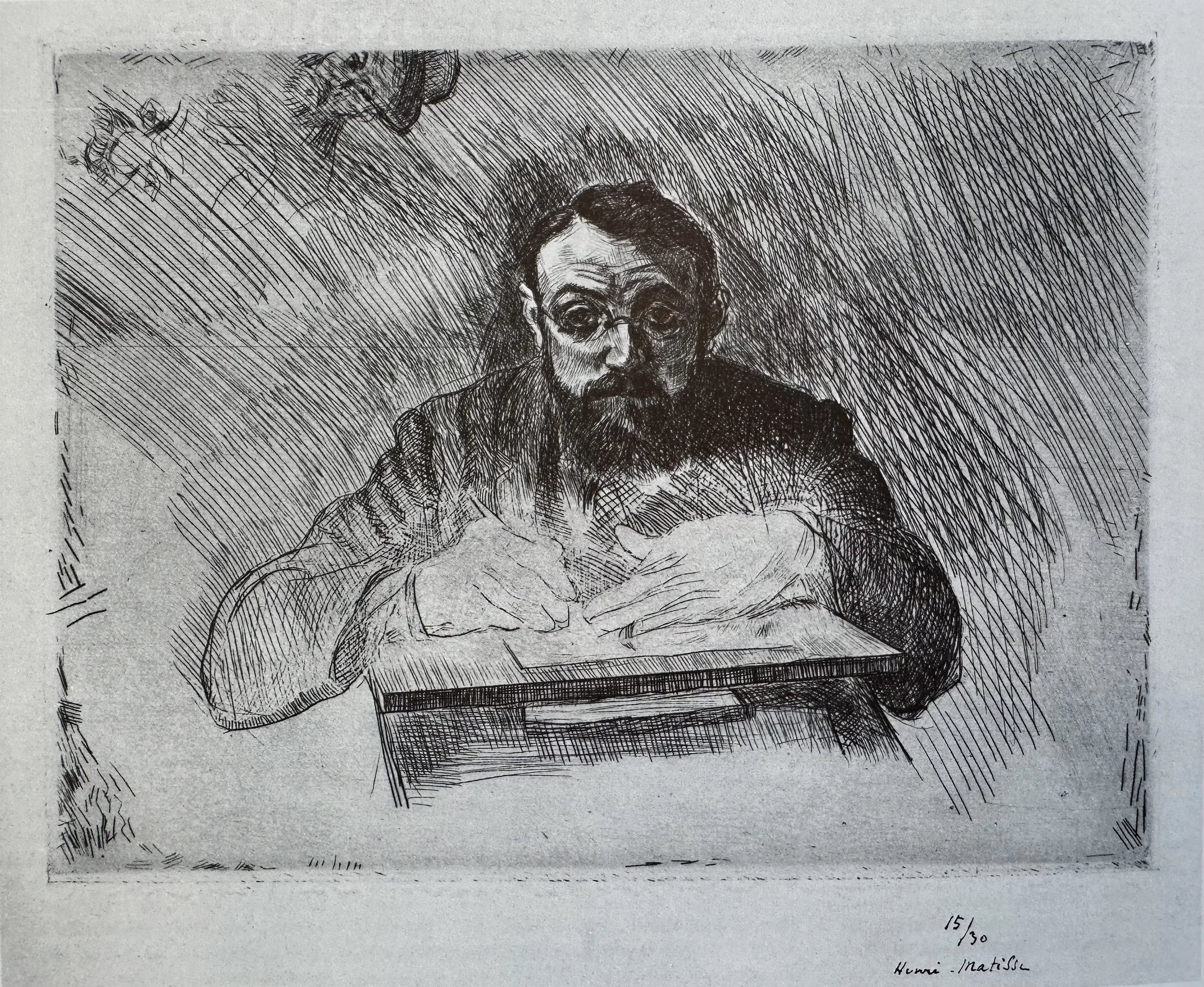
Henri Matisse Etching (1900 - 1903)

Matisse’s Early Years 1869-1908

Video Password: Early
Video Length: 9:43 minutes


1869
Born in Le Cateau-Cambrésis, northern France, son of a grain merchant.

1889
Given a paint box while recovering from illness—begins painting obsessively and decides to dedicate his life to art.

1895–1900
Studies under Symbolist paint Gustave Moreaus at the École des Beaux-Arts, Paris, Forms lasting friendships with Albert Marquet and and other future Fauves.

1904–1905
Works alongside Paul Signac; experiments with Neo-Impressionist Pointillism before breaking free. Summer in Collioure with André Derain is electrifying.

1905
Fauvism explodes onto the scene. The Salon d’Automne exhibition shocks Paris. Critics call Matisse and his circle les fauves — “the wild beasts” — for their savage, non-naturalistic colour. Woman with a Hat scandalises and fascinates in equal measure.

1906–1913
Travels to Morocco and Algeria; Islamic geometric art and vivid North African light permanently transform his sense of pattern, decoration, and colour harmony. Paints the great series The Dance and Music for Russian collector Sergei Shchukin.


▪ END OF INTRODUCTION ▪